Context: Campaign music
Campaign songs used for hundreds of years to connect with voters and send messages about candidates (Schoening and Kasper 2011, Peterson 2018). Technology makes it easy to curate and share playlists.
Theory
- Different models of representation borne out in types of songs chosen:
- Delegate models center on the notion of a representative as an agent on behalf of their constituents
- ‘We’ over ‘I’
- Morality-focused
- Brand model (Mansbridge’s gyroscopic model) is centered upon the representative as the commodity {.fragment}
- ‘I’ over ‘we’
- ‘Signature’ elements, such as songs
Data
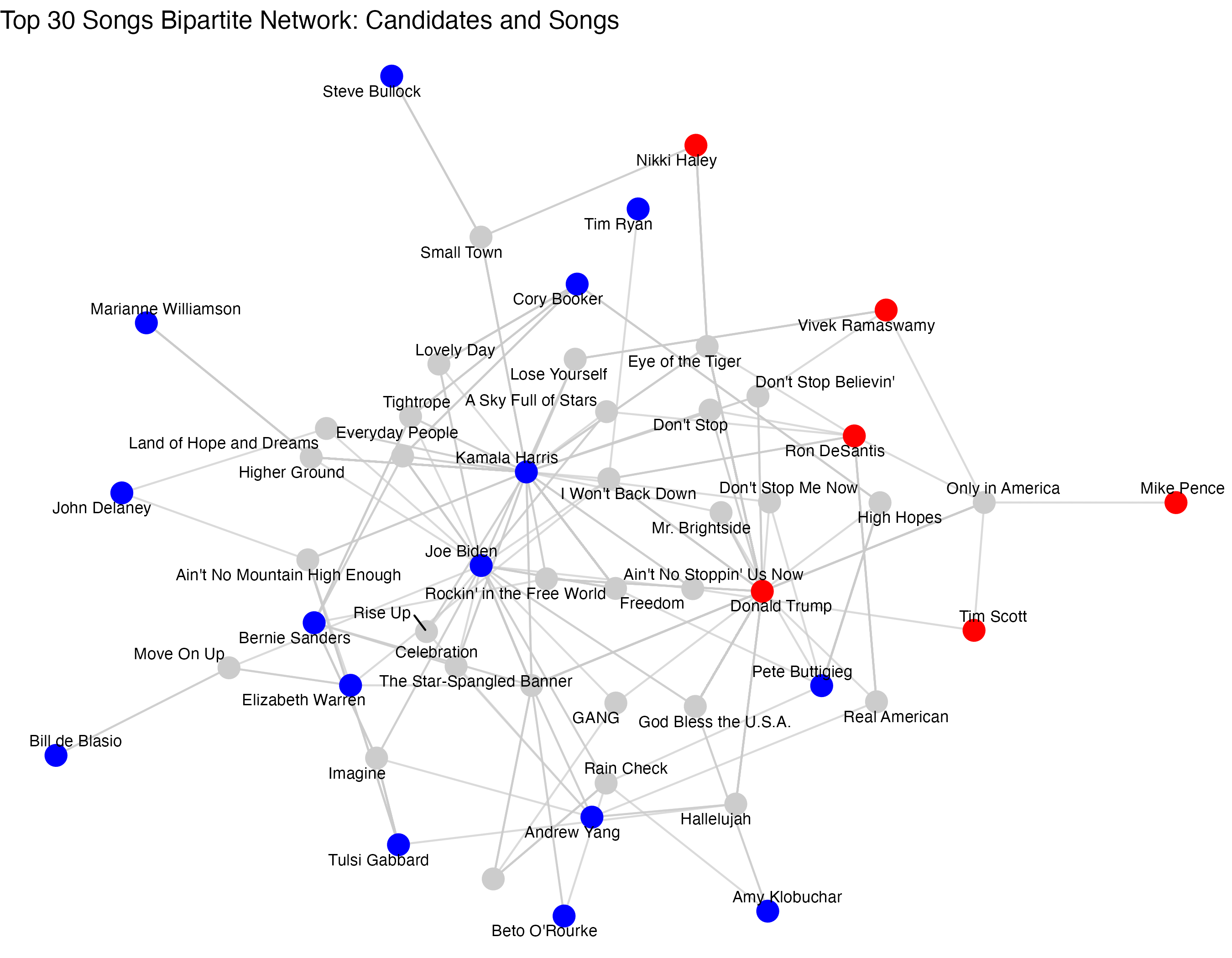
Data based on Trax on the Trail Database, focusing upon candidate-focused events (campaign launch, rally, stop, playlist, speech, town hall). Lyrics sourced from a combination of and .
- Approximately 2000 songs for candidates with more than five songs on a playlist and more than five campaign-related events.
- Approximiately 900 distinct songs represented
- 19 unique campaigns in 2016, 2020, and 2024
Methods
Use of three primary methods:
- Lexicon-based text analysis (NRC Emotion Lexicon and Linguistic Inquiry Word Count (LIWC)))
- Topic Models (LDA (Latent Dirichlet allocation))
- Principal Component Analysis (PCA) of relevant terms
NRC Emotion Lexicon
NRC use
Songs have tallies for each emotion and these are aggregated by candidate in the analysis
Sentiment and emotions: NRC
Using the NRC emotion lexicon, I incorporate eight emotions:
- Disgust
- Anger
- Fear
- Sadness
- Trust
- Anticipation
- Surprise
- Joy
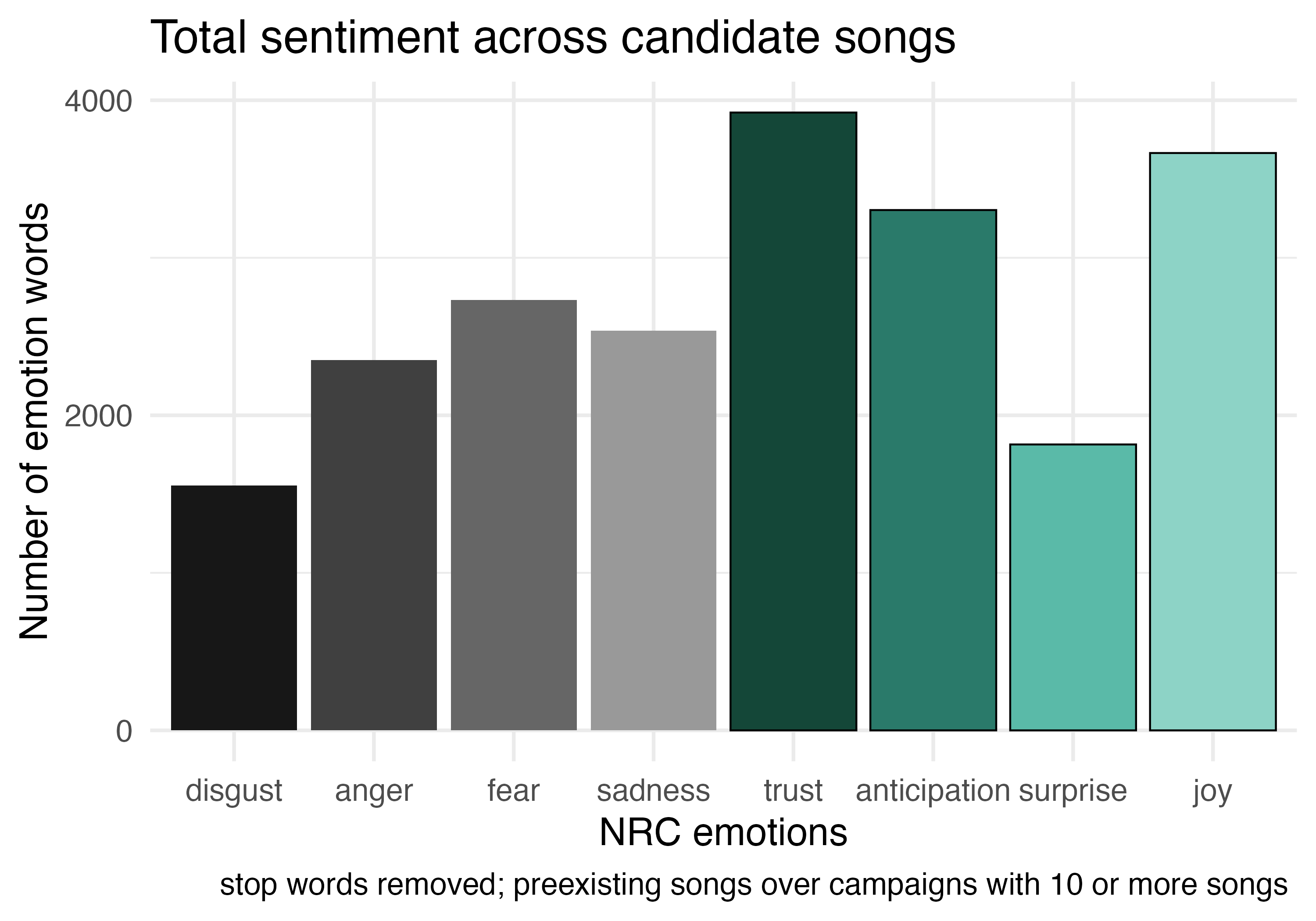
Sentiment and emotions: Overall
![]()
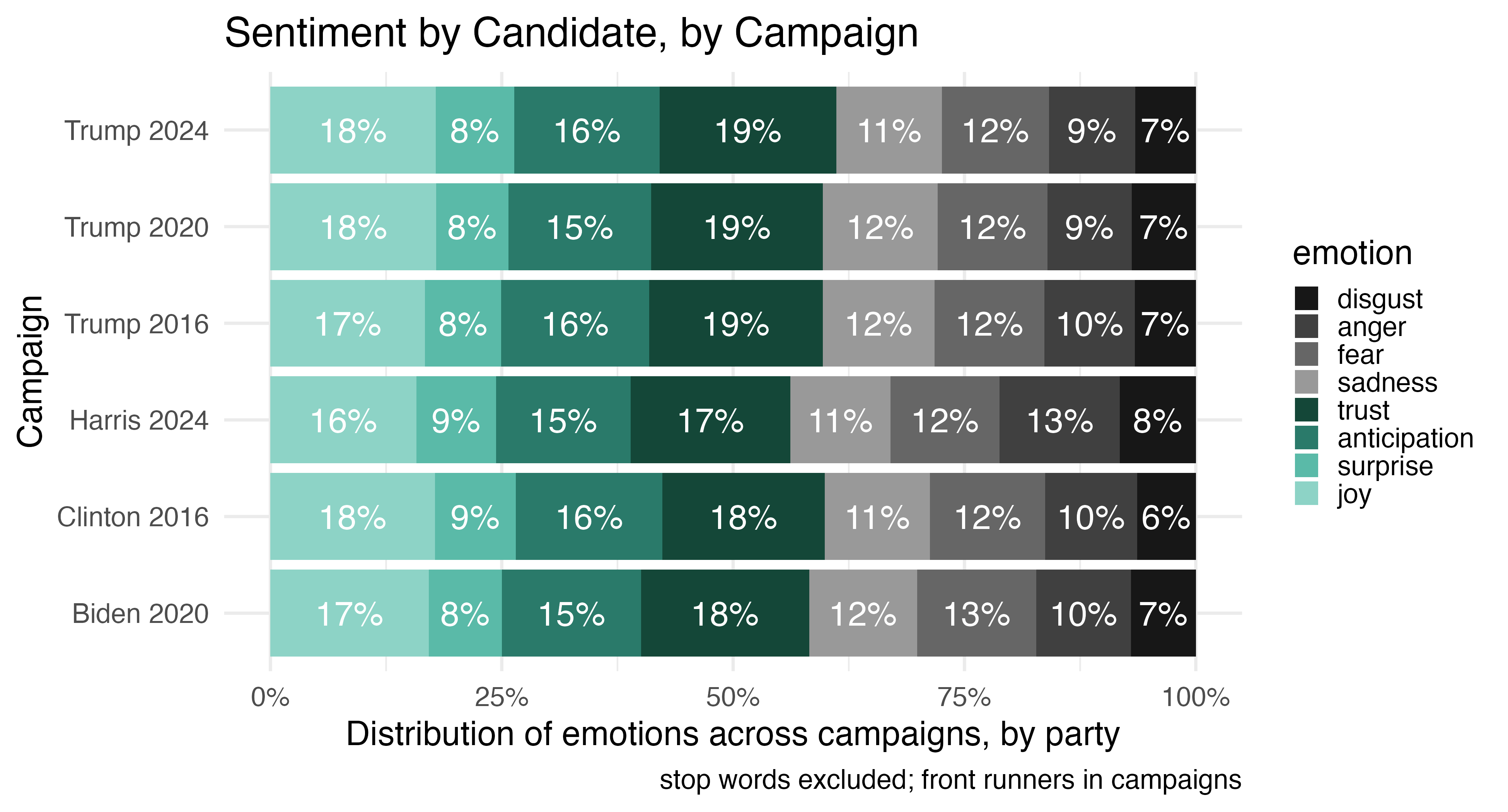
Sentiment and emotions: by candidate
Overall, candidates from both parties incorporate songs with ‘trust’ as the most common emotion.
![]()
Language and themes: LIWC
Linguistic Inquiry Word Count (LIWC) incorporates measures of linguistic use, which I use for its indicators of the following:
- Linguistic terms:
- pronoun use, such as I, we, she/he, and they
- Analytic language: use of logical language, including causal language
- Social terminology:
- including prosocial language, moral language, and conflict
- gendered terms/social references: male vs female
Themes: social behavior
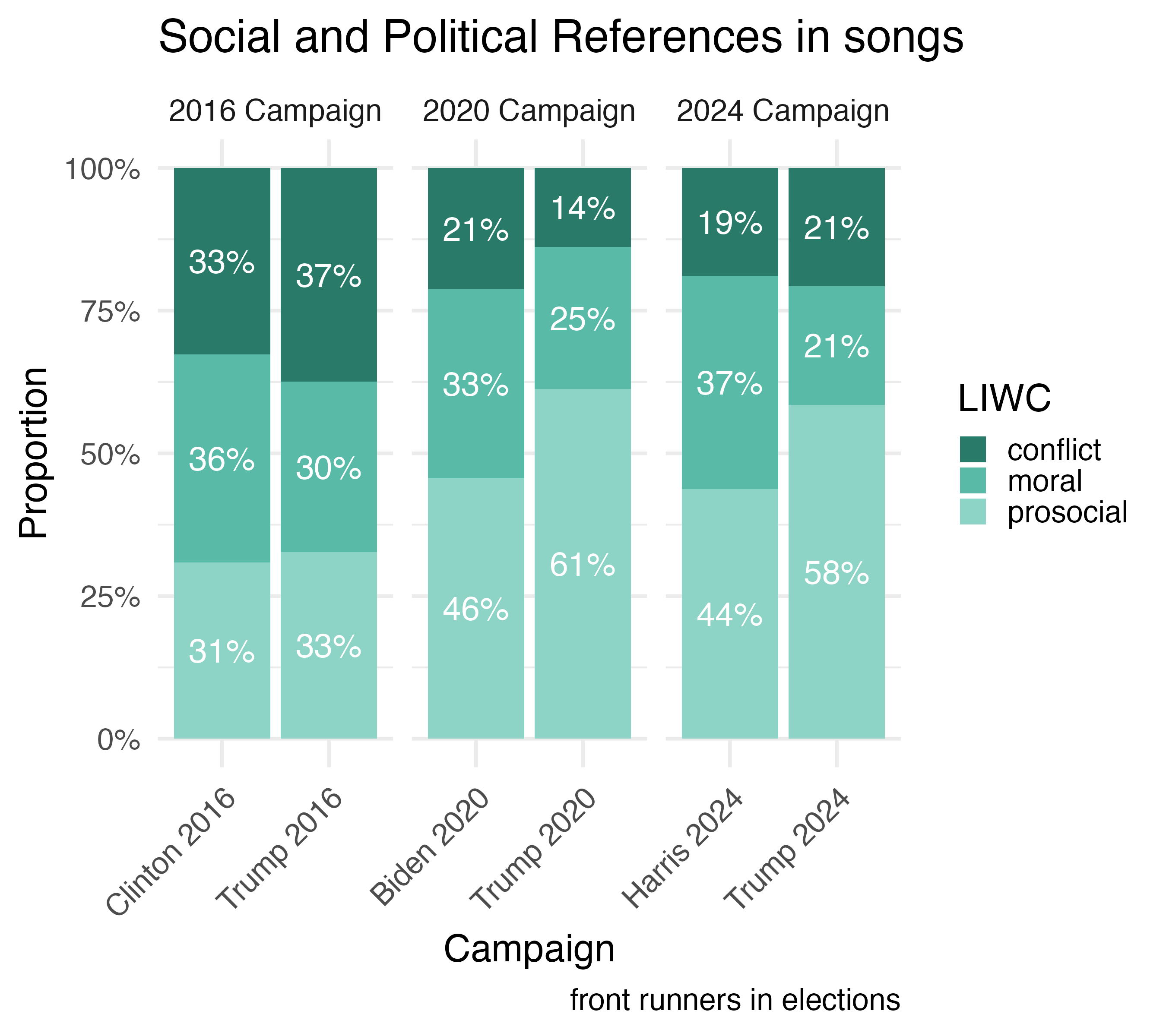
All candidates increased the use of songs with prosocial language over the elections with Democratic candidates employing more moral language in their song choices and Trump nearly doubling the ratio of prosocial language in playlists.
Topics: approach
Incorporated a topic model on the lyrics from all campaign songs.
Set topic numbers from 1 to 20 to find the best number of topics, incorporating two measures from CaoJuan2009 and Deveaud2014.
Latent Dirichlet Allocation model: model maps documents to fixed number of topics (five for this setup)
Topics
table output
|
Rank
|
Energizing music
|
Golden era
|
Feel good celebration
|
Love and happiness
|
Empowerment anthems
|
|
1
|
shake
|
time
|
babi
|
love
|
girl
|
|
2
|
high
|
life
|
love
|
day
|
back
|
|
3
|
gotta
|
gonna
|
wanna
|
peopl
|
happi
|
|
4
|
babi
|
heart
|
night
|
world
|
make
|
|
5
|
tip
|
back
|
stop
|
burn
|
run
|
|
6
|
jump
|
golden
|
feel
|
man
|
work
|
|
7
|
power
|
make
|
danc
|
give
|
thing
|
|
8
|
low
|
livin
|
good
|
make
|
woo
|
|
9
|
bout
|
long
|
tonight
|
start
|
gon
|
|
10
|
song
|
born
|
music
|
dream
|
money
|
|
11
|
play
|
home
|
alright
|
train
|
bitch
|
|
12
|
home
|
love
|
walk
|
woman
|
hand
|
|
13
|
worri
|
stand
|
gonna
|
higher
|
rock
|
|
14
|
gonna
|
freedom
|
bodi
|
live
|
hold
|
|
15
|
thing
|
light
|
talk
|
come
|
feel
|
Topics
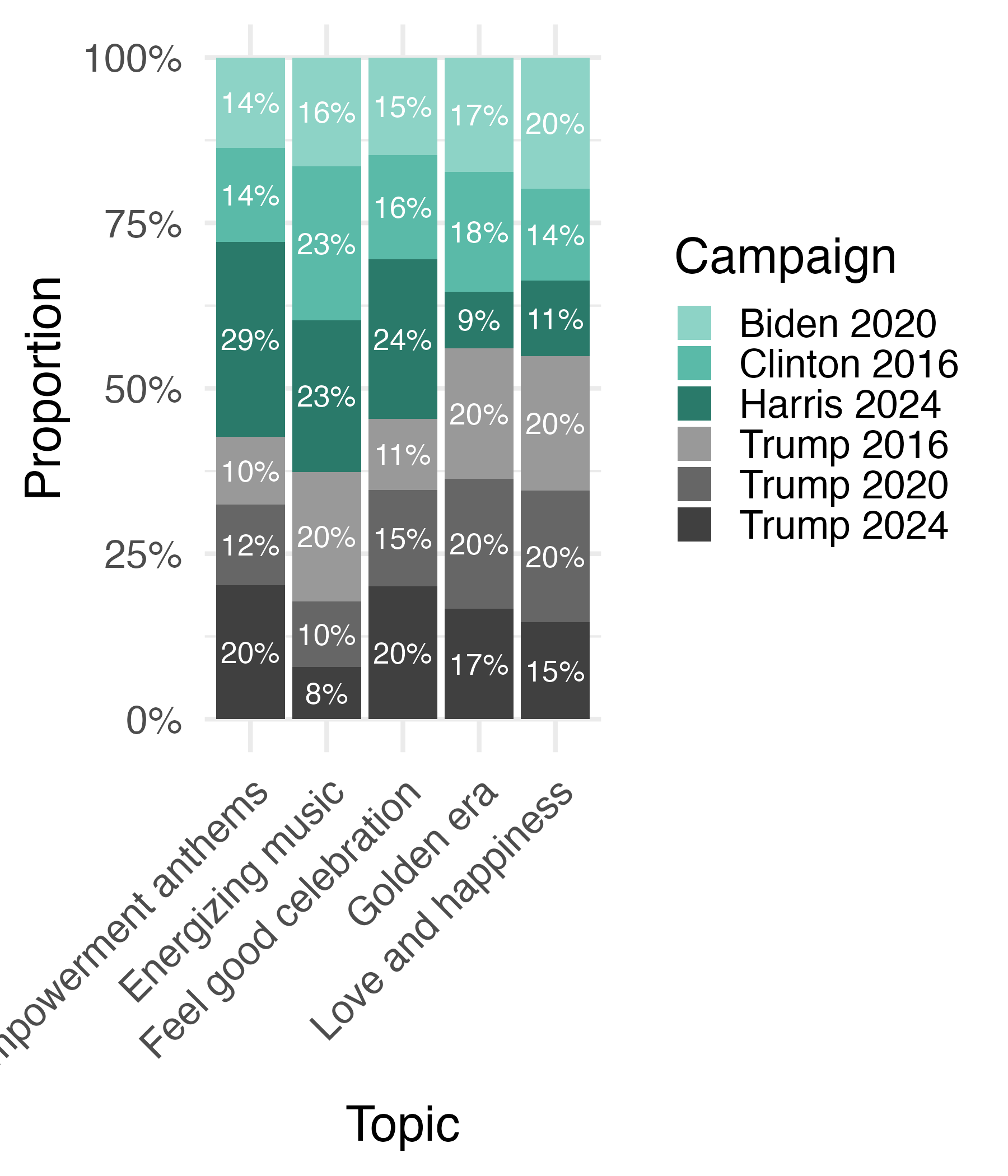
Trump has leaned toward more ‘feel good’-type music while Harris had empowerment anthems.
Principal Component Analysis (PCA): explanation
Principal Component Analysis offers a way to preserve the variation in the underlying data while reducing the number of variables present.
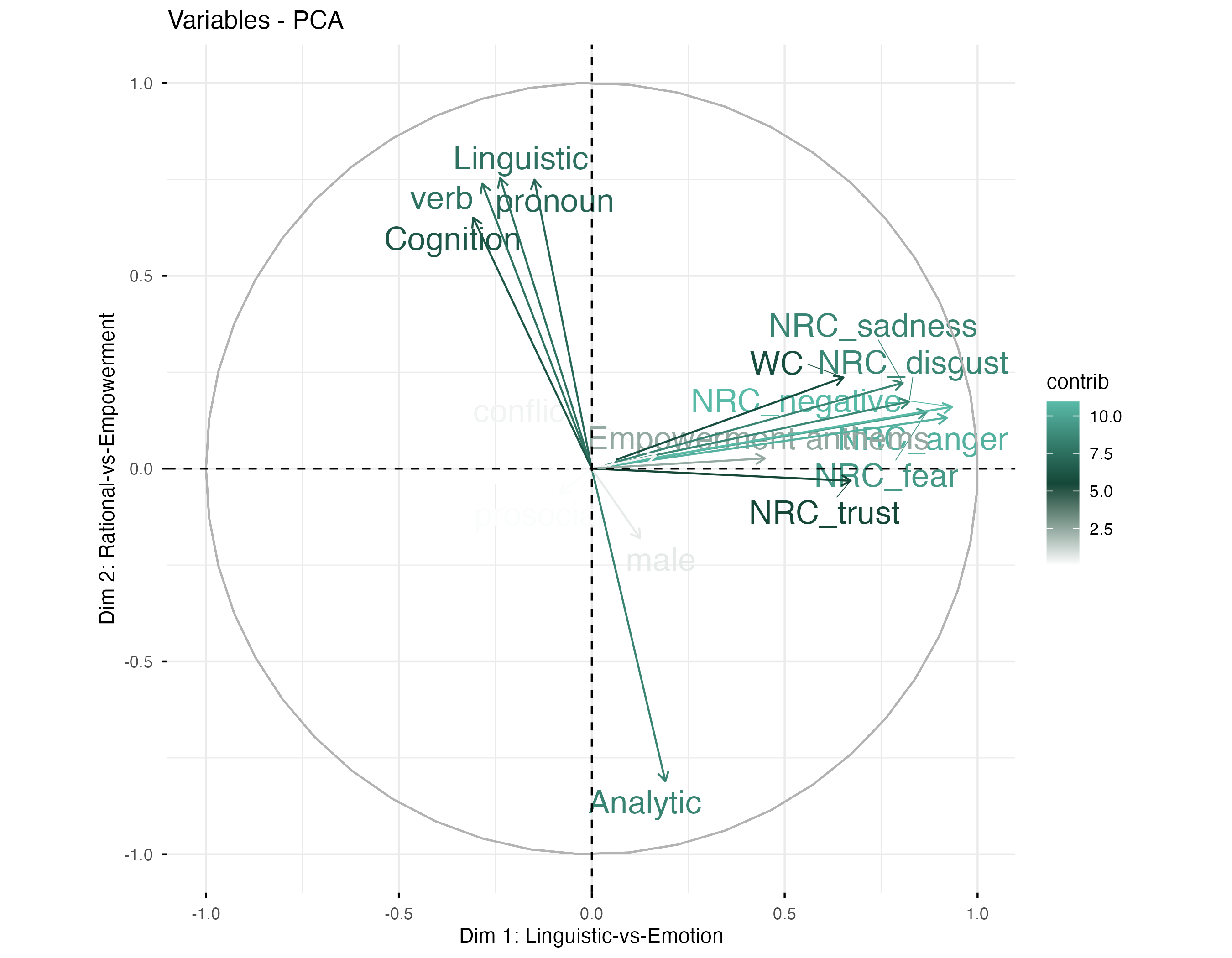
Variables are reduced through identifying relevant dimensions and collecting variables together.
Researchers name the dimensions thematically based on the variables present within the dimensional space
PCA: Candidate ‘spaces’
There are three distinct spaces:
Linguistically focused (particular language and pronouns present)
Emotional
Analytical or logical language
Candidate ‘spaces’
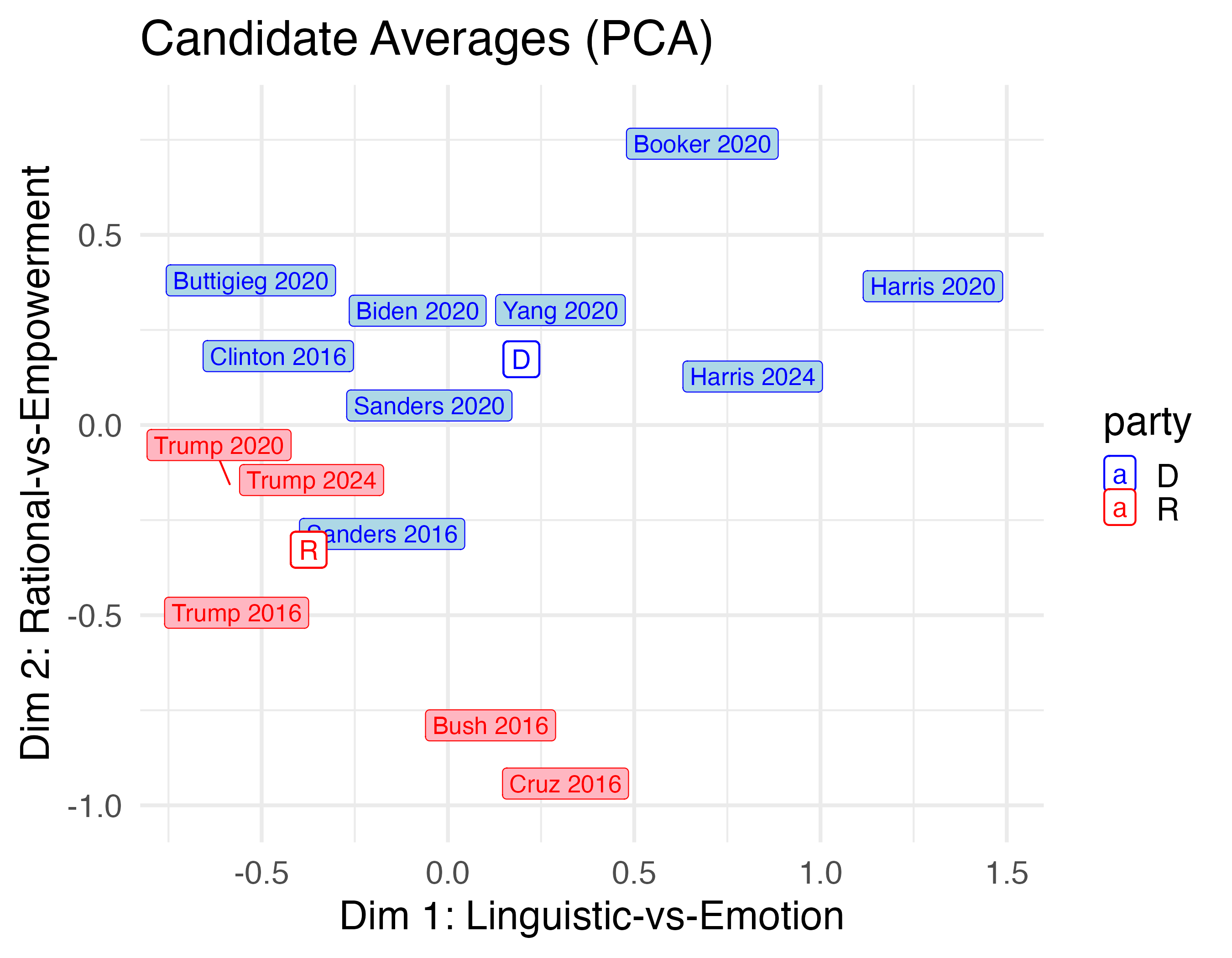
Distinct landscape: Trump and Sanders and Years of Harris
![]()
Conclusions and future research
- Campaign music relevant to candidates and key differences across parties and campaigns:
- Pro-social language: all candidates increased, but particularly Trump
- Moral language: reduction by Trump and increase by Democratic candidates
- Generally more negative emotion by Democratic candidates but all candidates incorporated trust