Why interdisciplinary studies are essential to the liberal arts

cultivated curiosity and the liberal arts education

Jean Clipperton, University of Chicago

Thesis up front:

Developing a sense of cultivated curiosity through an interdisciplinary liberal arts education can equip you to succeed in the classroom and beyond (students AND faculty!!!)

Agenda

  • My Simpson journey
  • Liberal arts and my research
  • Building on your foundation

About me

My Simpson journey

  • ‘Recruited’ as math major (actually had my deposit in elsewhere)
  • Liked the small college environment (smaller than my highschool)
  • Knew I wanted to study abroad (Nicaragua!)
First classes

  • Honors Liberal Arts Seminar in Philosophy
  • Math: calculus
  • Spanish

Ultimately was a Math, Philosophy, and Spanish major with a Latin American Studies minor
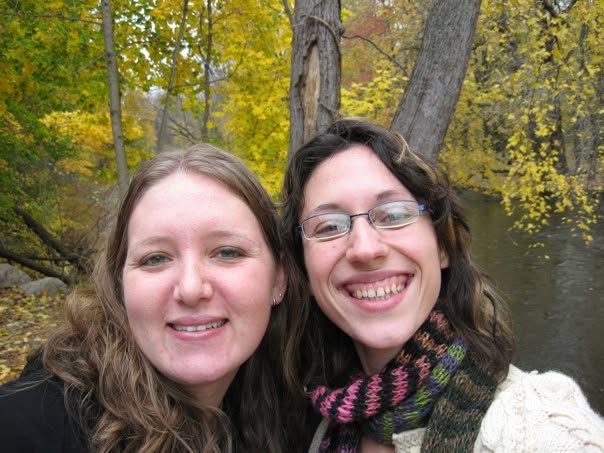
Zero chill but lots of fun

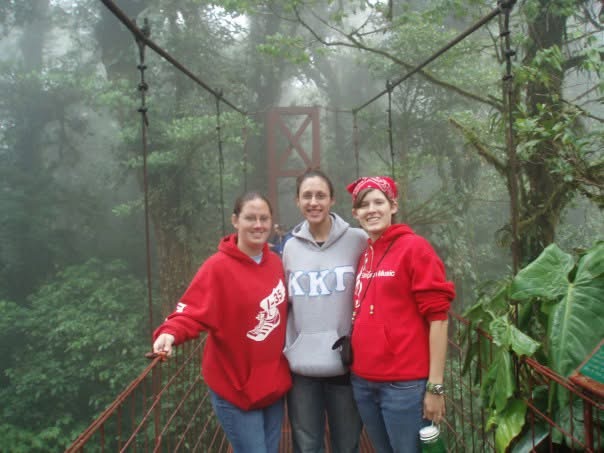
  • Involved across campus
  • Yearbook and newspaper
  • Coffee shop
  • Tutor + ‘TA’
  • Greek life
  • Math club
  • Math modeling competition

Academic journey

Study abroad and math modeling competitions changed my life … because I had a wide foundation to draw from

Graduate school:

  • Pursued a PhD in Political Science
  • University of Michigan for Complex Systems
  • Knew I loved teaching

An interdisciplinary life:

Interdisciplinary research:

  • Blends ideas from multiple disciplines
  • May or may not have an interdisciplinary ‘home base’
  • Can provide broader and deeper insights because you have a rich range of theories and ideas

Interdisciplinary work: an example

Applications

  • Epidemiological models can be used both to understand the spread of disease but also the spread of viral trends
  • Systems dynamics models can be used to understand populations (e.g. predators and prey) but also how cultures evolve and change

Personal and Professional life

  • My work spans multiple disciplines—I collaborate with diverse colleagues and draw on different areas of training:
    • Philosophy: analytical thinking and argument construction
    • Mathematics: rigorous problem-solving
    • Computer Science: computational implementation
    • Political Science: synthesis of complex literatures, institutional analysis
    • Sociology: navigating cross-cultural and interpersonal dynamics
    • Psychology: construction of meaning and understanding, framing

Small aside: An ongoing battle with a school district

Professional life: Music research

Political campaigns provide an opportunity for candidates to provide information about themselves and the representatives they will become.

Research project: It’s a new soundtrack: Candidates, Campaigns, and Playlists


Campaigns provide

  • Opportunities to signal their qualities (delegate model (Mansbridge 2003, 2011))
  • Information about their ‘brand’ (gyroscopic model (Mansbridge 2003, 2011), ‘brandidate’ (Kaneva 2016, Harrison 2022))
  • Context for voters (both informed and uninformed) (Bonilla 2022, Roumanias 2005)

Theory: models of representatives

  • Delegate models center on the notion of a representative as an agent on behalf of their constituents
    • Collective-focused
    • ‘We’ over ‘I’
    • Principled: what is ‘right’ from an ethical or moral perspective
  • Brand model (Mansbridge’s gyroscopic model) is centered upon the representative as the commodity
    • Self-focused
    • ‘I’ over ‘we’
    • Determines what is ‘right’ from own perspective
    • Typically resolute

Context: Campaign music

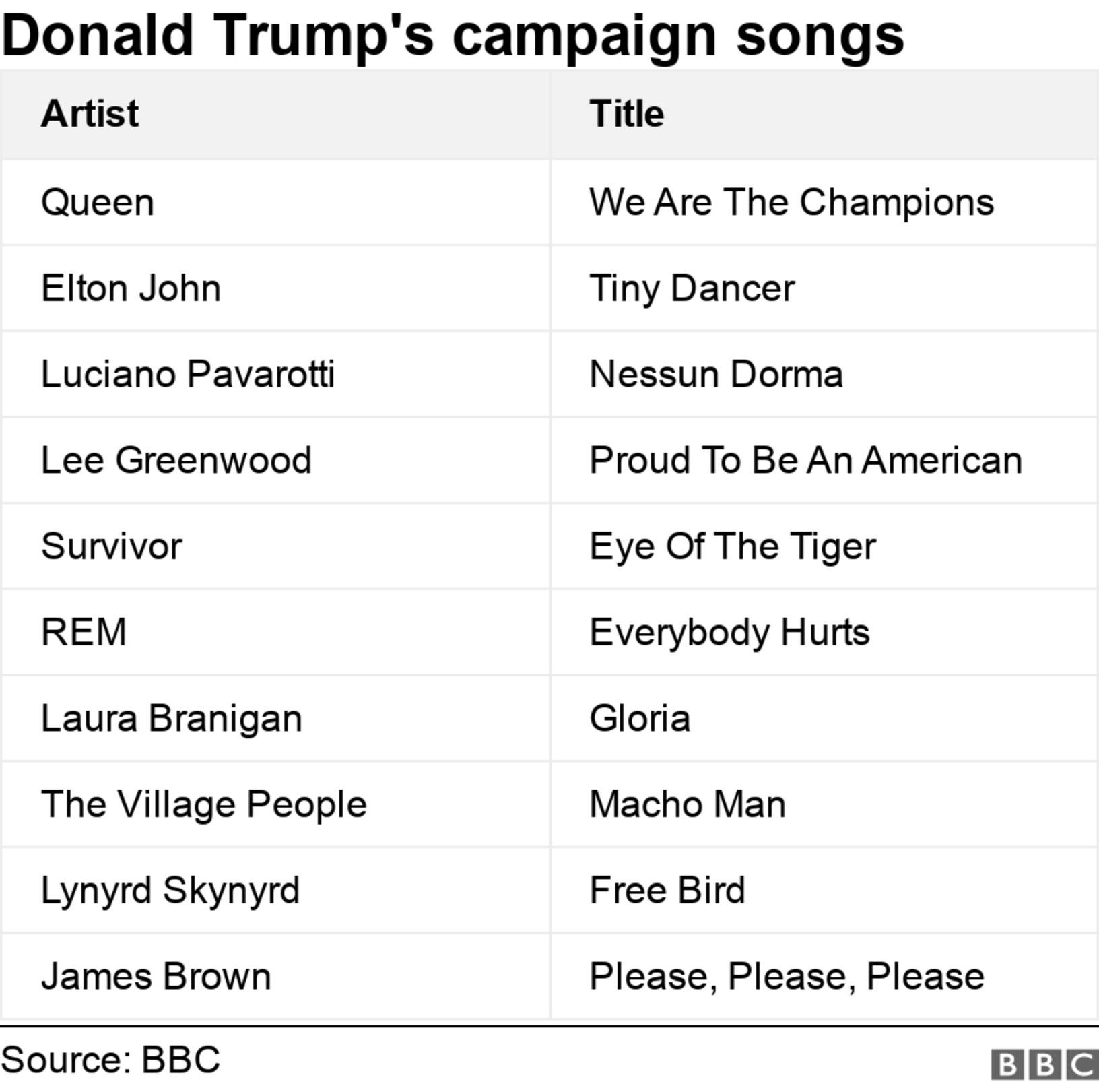
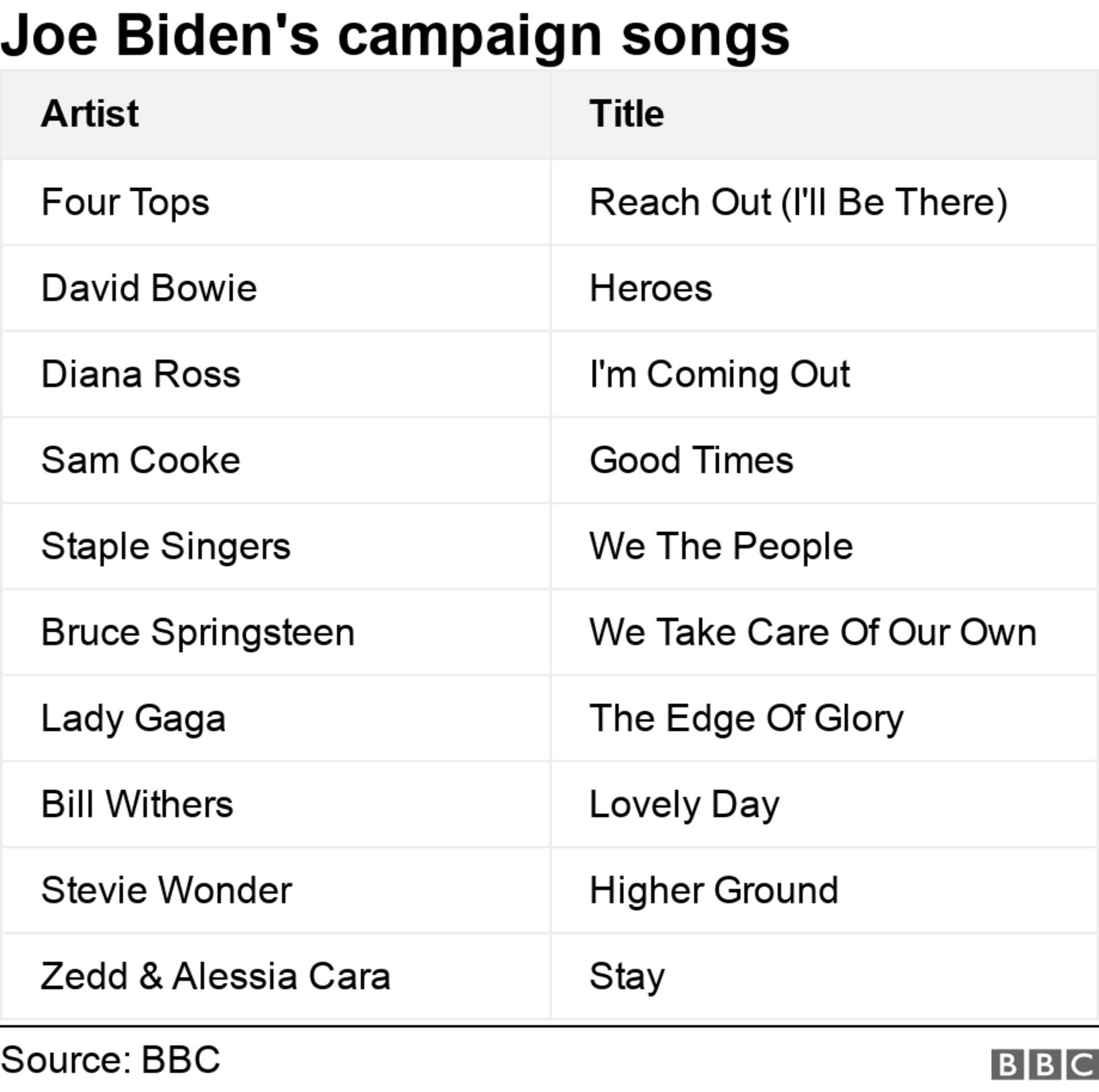
Campaign songs used for hundreds of years to connect with voters and send messages about candidates (Schoening and Kasper 2011, Peterson 2018). Technology makes it easy to curate and share playlists. ::: {.fragment}
:::

Source: BBC

Data

Data based on Trax on the Trail Database, focusing upon candidate-focused events (campaign launch, rally, stop, playlist, speech, town hall). Lyrics sourced from a combination of and .

  • Approximately 2000 songs for candidates with more than five songs on a playlist and more than five campaign-related events.
  • Approximiately 900 distinct songs represented
  • 19 unique campaigns in 2016, 2020, and 2024

Methods

Use of three primary methods:

  • Lexicon-based text analysis (NRC Emotion Lexicon and Linguistic Inquiry Word Count (LIWC)))
  • Topic Models (LDA (Latent Dirichlet allocation))
  • Principal Component Analysis (PCA) of relevant terms

Themes: social behavior


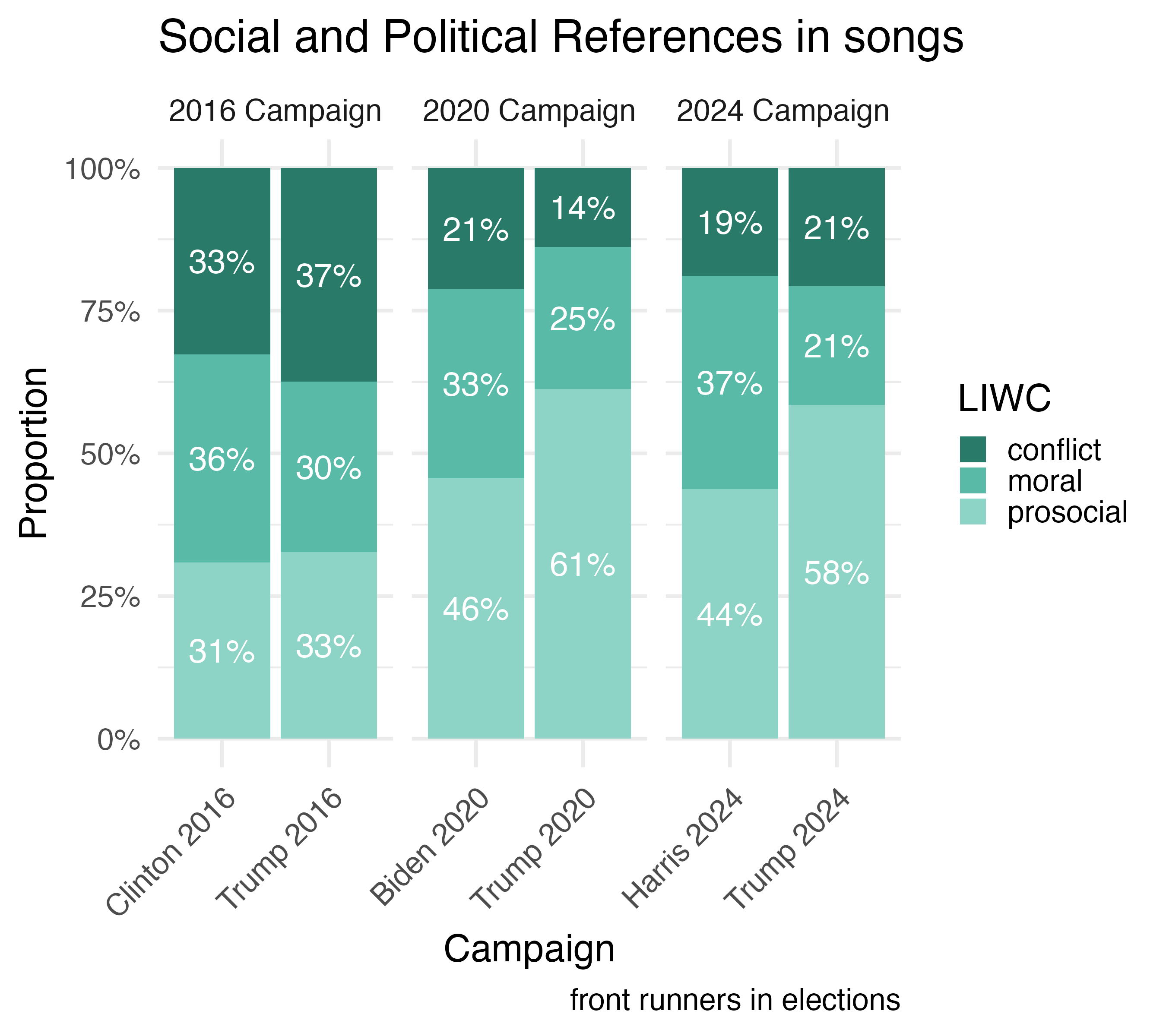
All candidates increased the use of songs with prosocial language over the elections with Democratic candidates employing more moral language in their song choices and Trump nearly doubling the ratio of prosocial language in playlists.

Topics
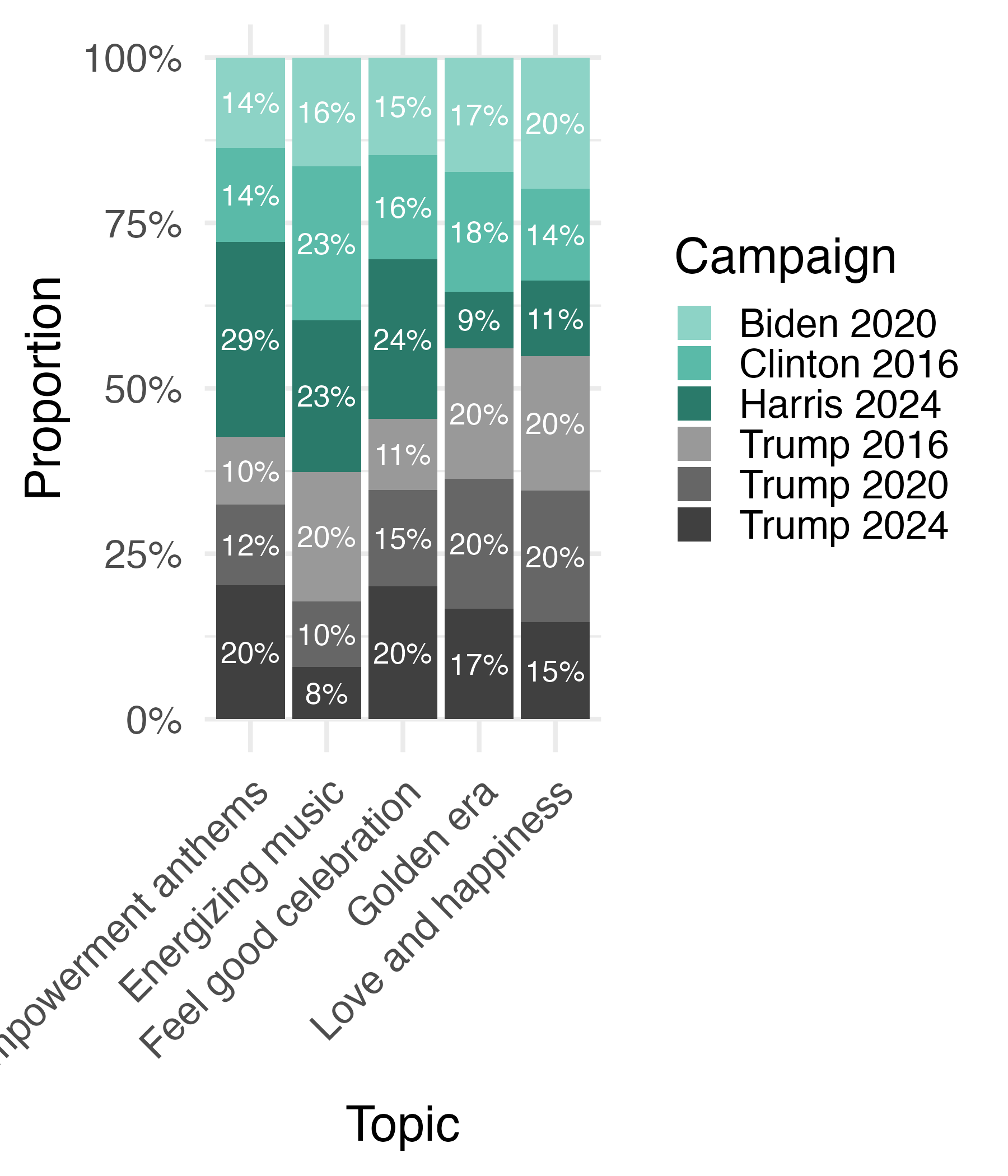
table output
Rank Energizing music Golden era Feel good celebration Love and happiness Empowerment anthems
1 shake time babi love girl
2 high life love day back
3 gotta gonna wanna peopl happi
4 babi heart night world make
5 tip back stop burn run
6 jump golden feel man work
7 power make danc give thing
8 low livin good make woo
9 bout long tonight start gon
10 song born music dream money
11 play home alright train bitch
12 home love walk woman hand
13 worri stand gonna higher rock
14 gonna freedom bodi live hold
15 thing light talk come feel

Topics


Trump has leaned toward more ‘feel good’-type music while Harris had empowerment anthems.

Principal Component Analysis (PCA): explanation

  • Principal Component Analysis offers a way to preserve the variation in the underlying data while reducing the number of variables present.

  • Variables are reduced through identifying relevant dimensions and collecting variables together.

  • Researchers name the dimensions thematically based on the variables present within the dimensional space

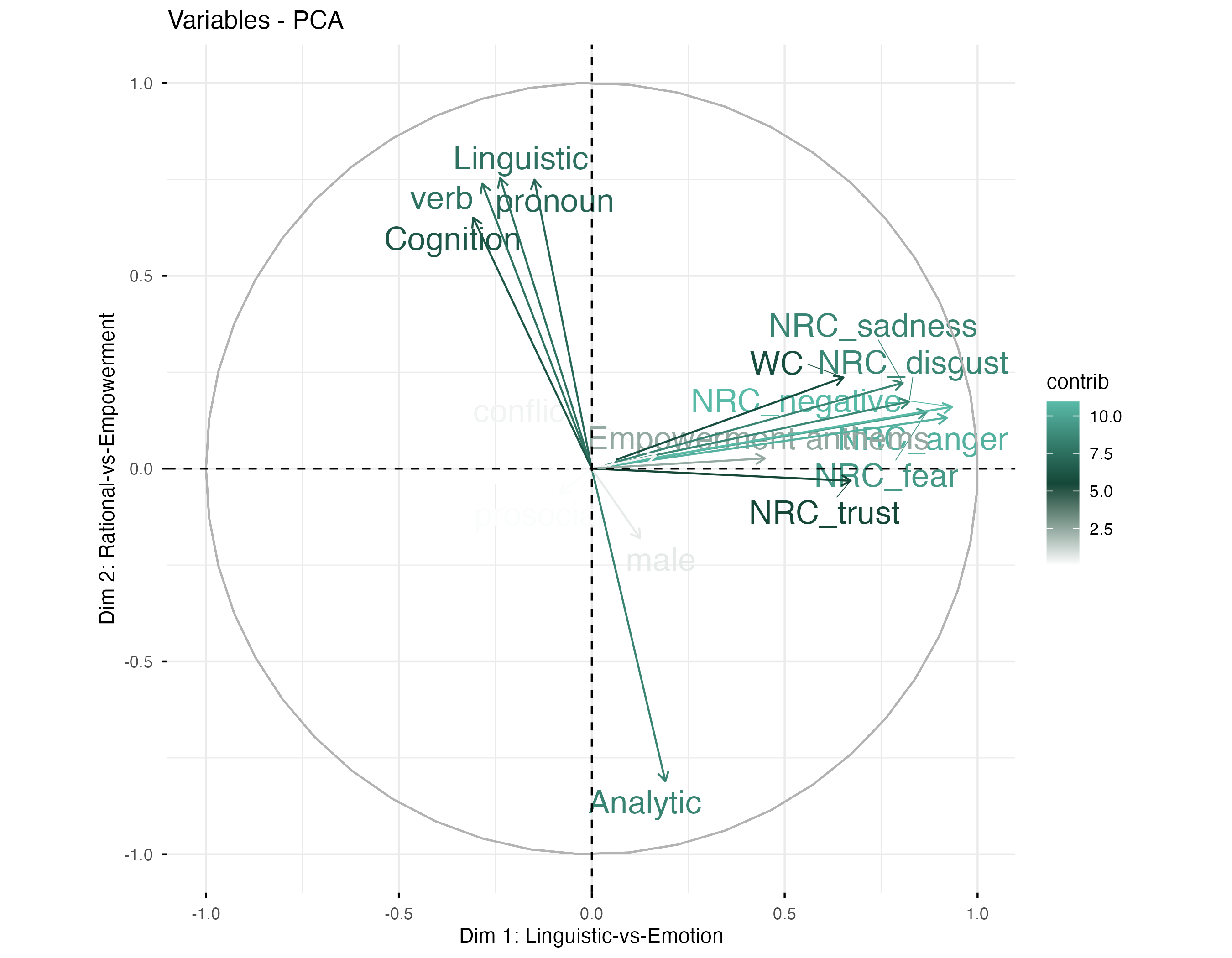
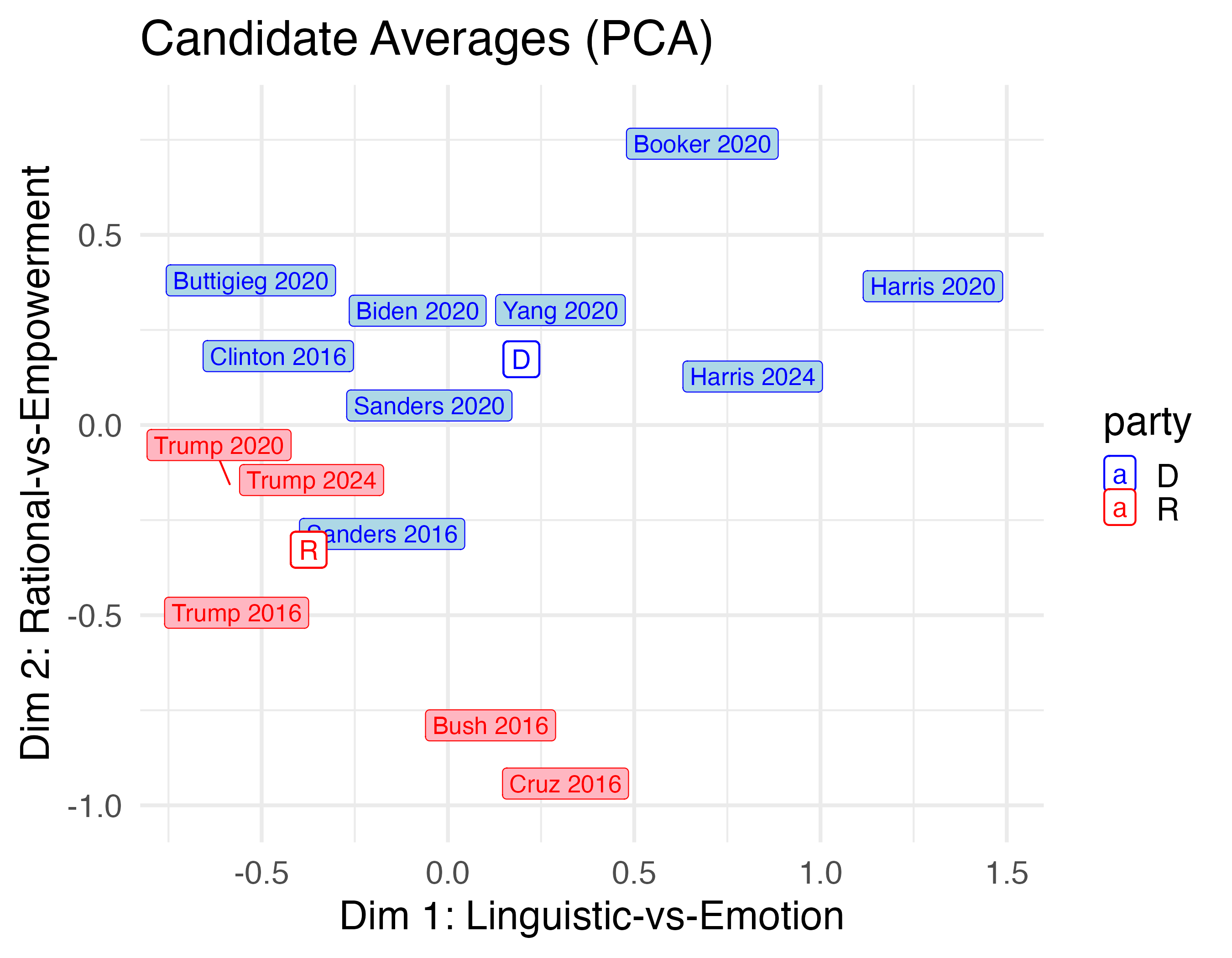
PCA: Candidate ‘spaces’


There are three distinct spaces:

  1. Linguistically focused (particular language and pronouns present)

  2. Emotional

  3. Analytical or logical language

Candidate ‘spaces’

Distinct landscape: Trump and Sanders and Years of Harris
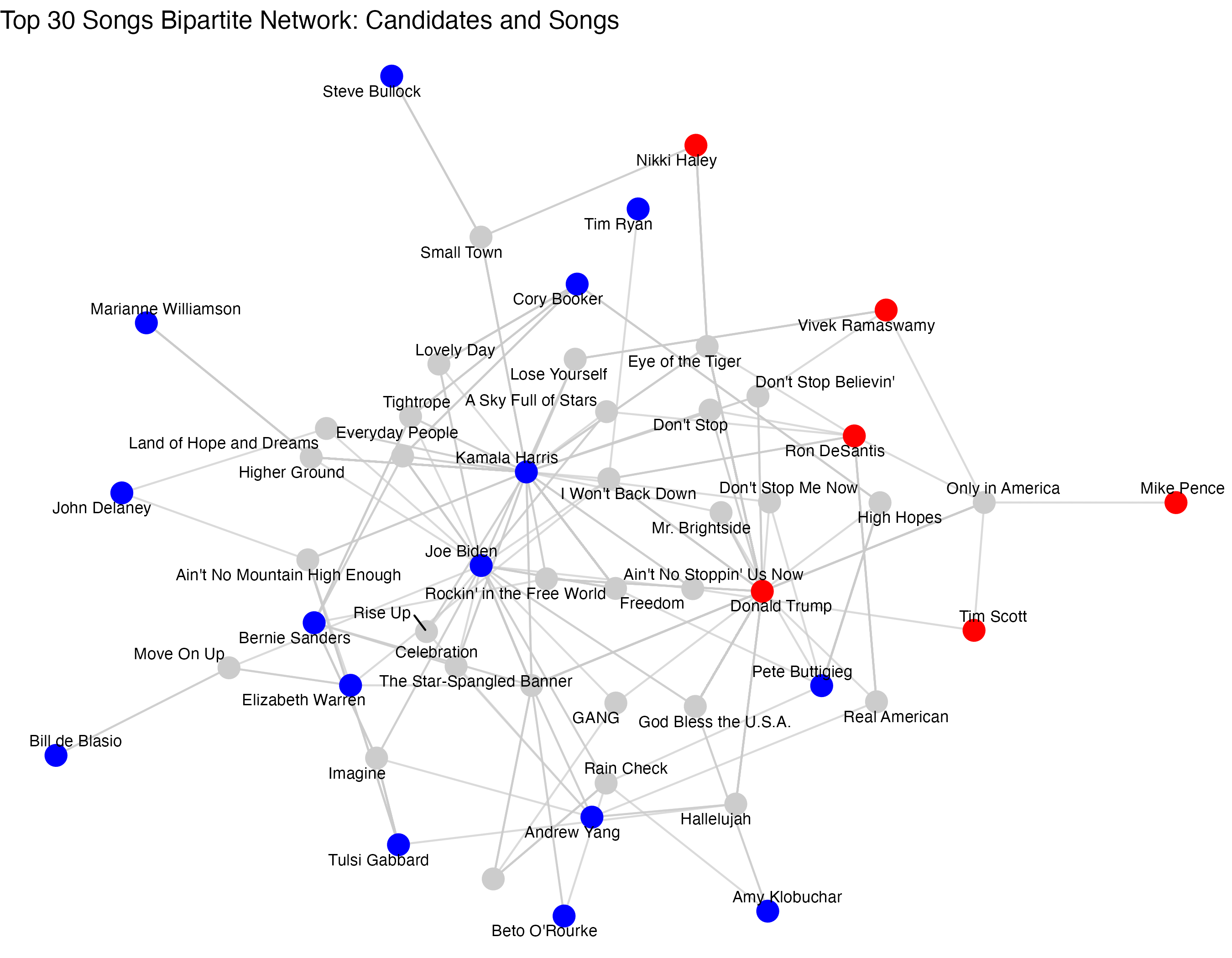
Overlapping songs
So WHAT????

Why bother with all this?

  • Problem solving skills
  • Better insights
  • Cooler at parties / work
  • Able to move ahead because you can be a go-between

Takeaways

STUDENTS!

  • INQUIRY: what are you interested in? what can you learn about it?
  • CULTIVATE your curiosity: approach questions from different perspectives
  • FIND something that interests you: LIFE IS FOR LIVING and it’s ok to do something for fun
    • Problem solving class w/Murphy Waggoner to think about how to bring what we know into the world
    • Philosophy of Language class w/John Pauley (and Prof Lieberman) on how we shape meaning and understanding
    • Music class w/Prof Albrecht and how major chords are coming home

PROFESSORS

  • Bring in real-world context whenever you can!
  • Teach cultivated curiosity … and how to think about questions and answers
  • Encourage and bring in different viewpoints

What does this look like in the classroom?

  • Problem-solving classes
  • Interdisciplinary teams
  • Student autonomy and choice in assignments

How did this get started?

This is my life now
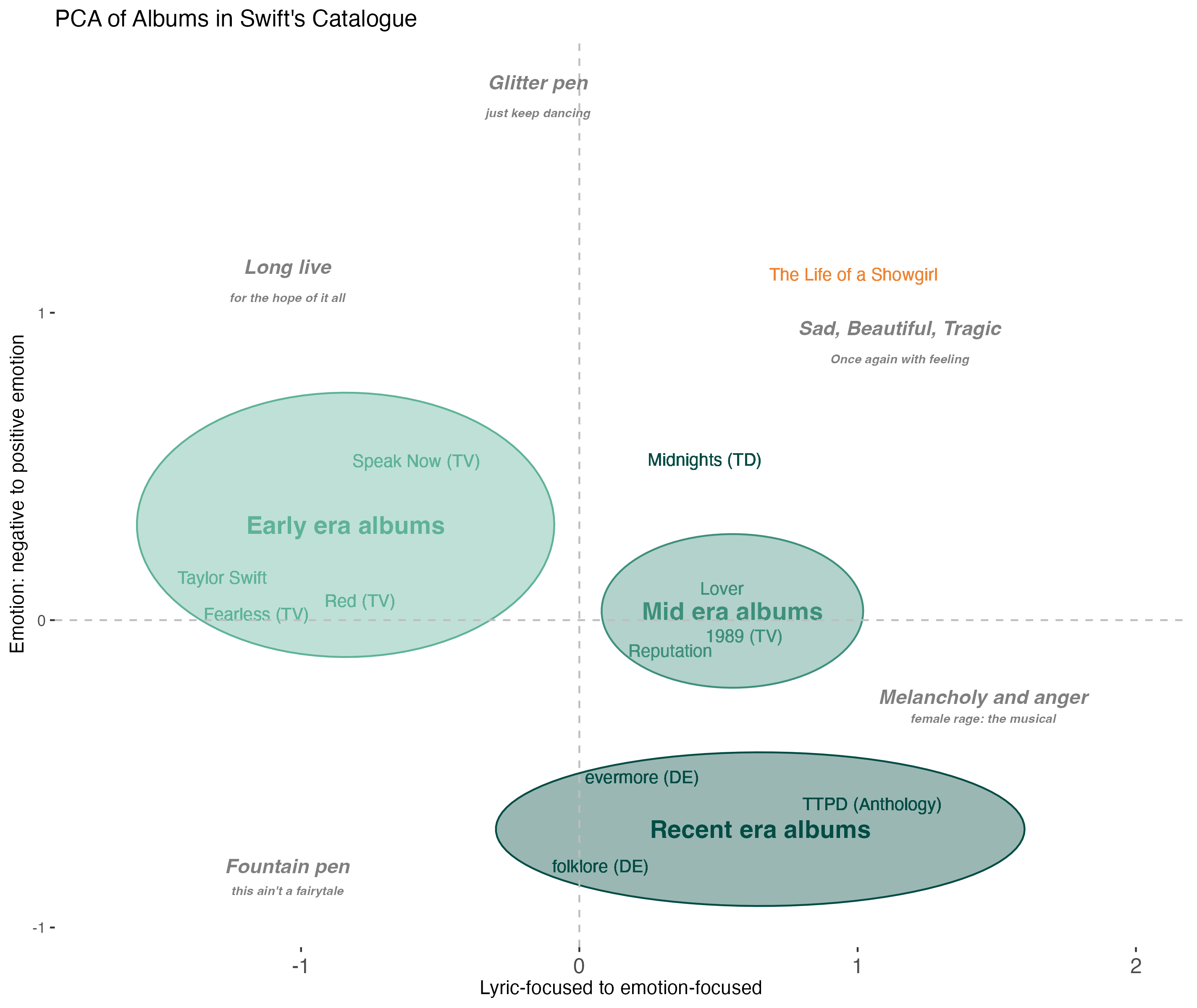
What will your next steps look like?

  • What are you interested in?
  • How can you build a strong base?
  • Seminar on ‘half-baked ideas’
  • Take advantage of your time here: tremendous opportunity for breadth

Cultivate a sense of curiosity about the world and your place in it … how hard could it be?

Thank you!

clipperton@uchicago.edu